
Header image description: A photo of the audience at Hozier’s concert on November 23, 2019, at the Hammerstein Ballroom in New York, taken from the stage. If you look closely, you can see the author in the front row, wearing a purple cap and black sweater. [Credit: Sydney Gawlik]
2019 was a pivotal year for me. I could list a number of reasons — professional, academic, and developmental ones — but honestly, the most indelibly positive changes stemmed from me becoming a die-hard fan of the Irish singer-songwriter Hozier.
Yes, out of all the things that happened that year — including the decision to pursue grad school, losing a few long-standing friendships, and turning twenty-one — I consider the most significant event in my life from that period to be my joining a new fandom.
I’d been a fan of Hozier for a while before this. I immediately fell in love with “Take Me To Church” the first time I heard it on the radio in 2014. I listened to his debut album not long after and, a couple years later, that album helped me get through a difficult first year of undergrad. But, I wasn’t connected to other fans; I didn’t have anyone with whom to discuss his music or go to a concert.
This changed in the months leading up to the release of his sophomore album, Wasteland, Baby!. Beginning in late 2018, I began to immerse myself in “hoztwt,” the loosely-formed Twitter fanbase surrounding the singer. Because much of hoztwt is white, I tweeted about my desire to create a group chat for nonwhite Hozier fans. However, I received a reply from a mutual named Milan saying that such a thing already existed — but specifically for Black fans. I was like Bet, add me. Folks have come and gone, but five years later, many members of this group chat — we call ourselves “the Legion” — are still here and we’re still very active.

By the time Wasteland, Baby! was released on March 1, 2019, I already had tickets to see Hozier in November of that year in New York. I didn’t know how I’d get there and I didn’t know who I’d go with, but I was determined to see my favorite musician live in concert. A few months later, he announced a show in Washington, D.C. — the city I live in — just a few days before the NYC show I had tickets to; I decided to buy tickets to the D.C. date, too, and go to both. There were a few other members of the Legion who lived in the DMV (D.C., Maryland, and Virginia) area, and we decided we’d go together.
On November 18, 2019 — the day of the D.C. concert — I left work early and got in line at about 3:30pm, though the show didn’t start until 8 o’clock. I wanted to get a good spot in the pit, so I bundled up, ensured that my phone was fully charged, and waited outside until the venue doors opened. My twenty-one year old body could handle the hours upon hours of standing necessary for this goal: once your ticket is scanned and you get past security, you can’t move for fear of losing your spot. So, from just before the doors opened at 7pm until his set ended around 10:30, I was on my feet.
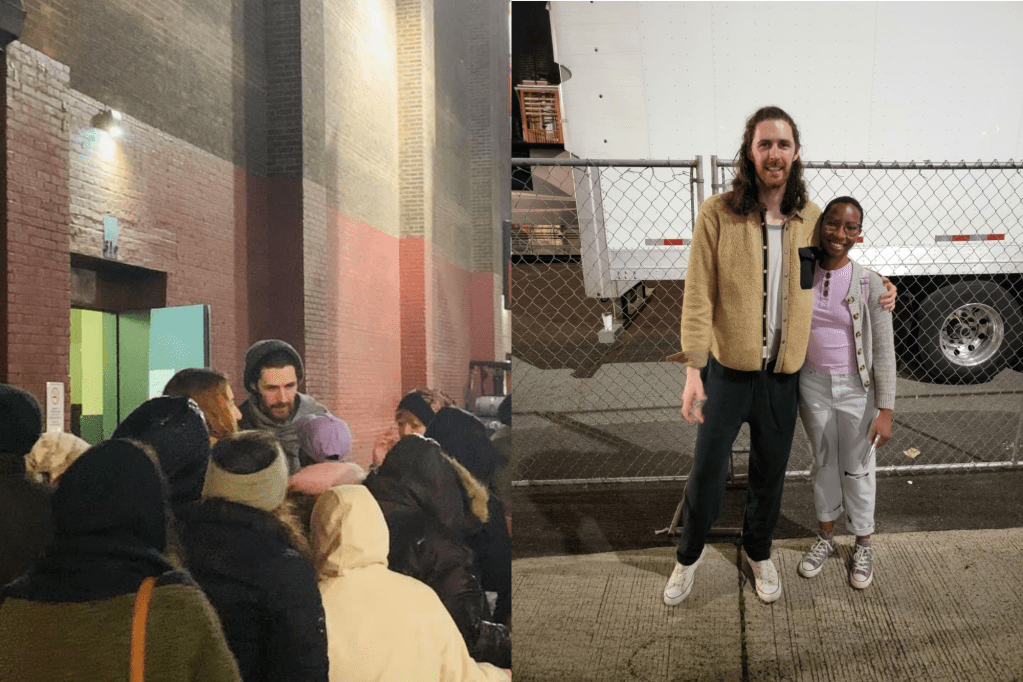
It was worth it because I got to be in the second row of the audience, inches away from Hozier when he leaned over the barricade while singing “Take Me To Church.” It was worth it to see the joy on Milan’s face when he took the bisexual pride flag she held out to him and draped it over his mic stand. It was worth it to be outside in the cold until 2:40am, the timestamp on my photo with him, his six-foot-six frame hunched over, signing my CD.
I’d learned from people who’d seen him earlier on that tour that, after his shows, he tended to come outside the venue and meet his fans, take pictures, and sign things for anyone who felt like waiting. He didn’t advertise these meet and greets, nor did he charge a special VIP ticket price to meet him. I couldn’t pass up my chance; though I had class and work the next day, I and the friends I went with stayed out late to get photos and an autograph and the opportunity to talk to our favorite artist.

As of today, I’ve seen Hozier in concert five times: twice in November 2019, once in D.C. and once in New York; and three times in 2023: one smaller pop-up show in May in D.C., a show at a medium-sized venue in D.C., and one show at a large amphitheater in Philadelphia, both in September. After the 2019 D.C. show and the pop-up show last year, I and many other fans had the opportunity to meet him, take pictures, and get his autograph. After the 2019 NYC show, which was one of his last shows on that tour, he personally came outside the venue to tell us that he wouldn’t be able to do his usual routine of meeting fans. I was hoping to be able to meet him at least once more during his 2023 tour, but it seems as if his days of doing free, informal meet-and-greets have come to an end.
Between his concerts five years ago and that smaller pop-up show last May, Hozier seems to have gotten exponentially more popular. In 2019, he was playing all medium-sized venues; I saw him that year at The Anthem in D.C. and the Hammerstein Ballroom in New York, both of which are able to fit a few thousand attendees. On his 2023 tour, he mostly played amphitheater- or arena-style venues like The Mann Center in Philly and the legendary Madison Square Garden (MSG), both of which can fit over fifteen thousand or so concertgoers.
(Funnily enough, when I was in line for the Hozier show at the Hammerstein Ballroom in 2019, the venue’s manager came outside to talk to those of us who’d been waiting in line all day. The manager said that “Hozier could easily sell out MSG, but it says a lot about him as an artist that he chose to play a run of five shows at a smaller venue like ours.” At the time, I didn’t fully believe him that Hozier could sell out MSG; but it’s been mostly heartening to see that statement made manifest.)
I’d heard that Hozier became even more popular in the first few years of the pandemic from people sharing his music on TikTok. However, it didn’t hit me until even I, the superfan who was in the Ticketmaster queue from the minute it opened, couldn’t get a ticket to his show in D.C. last September. (Thankfully, my friend Oli had an extra ticket when one of their friends couldn’t go, which is how I got to attend.) It was at that moment that I finally realized my beloved favorite musician had become many people’s beloved favorite musician. And, to be quite honest, I was kinda miffed.

Let’s be real: new fans of Your Thing are always at least a little bit annoying, no matter how much grace you have for them. It’s been strange to hear the same conversations and arguments we were having in 2019 be played out yet again. Yes, his song “Cherry Wine” is about an abusive relationship, so maybe don’t play it at your wedding. Despite the popular belief that he’s somehow the heir apparent to a long line of white women writers, Hozier is very explicit about the fact that his artistic influences are literary figures like James Baldwin and Black American women musicians including Nina Simone and Mavis Staples. Yes, he’s very tall — like, taller than you think. Yes, he is straight. Yes, a lot of his music is incredibly horny.
Don’t get me wrong, I’m not trying to gatekeep Hozier or his music; I’m happy that thousands of people are discovering joy in artistry that I find immense joy in. However, there’s also some sadness in seeing a relatively small, intimate community of fans become mainstream.
In 1989, Dr. Kenneth Doka coined the term “disenfranchised grief” to describe the feeling a person gets when they experience a loss that isn’t acknowledged as significant by dominant Western society. People may experience feelings of disenfranchised grief after the deaths of non-biological loved ones or complicated relationships (like that of an estranged family member). However, this phenomenon also covers non-death losses; for example, many young people felt disenfranchised grief when COVID lockdown postponed, cancelled, or changed the format of major life events, such as graduations, proms, and the first year of college or postgrad life.
While a famous person — whose work I care about, but whom I don’t actually know — becoming more of a household name doesn’t rise to the level of grief for me, I do feel a bit of sorrow for what is lost when a beloved part of your life suddenly becomes chic. The thing about trends is that, while increased visibility can lead to many people discovering something they really and truly love, it also necessarily comes with people who hop on said trend just because they can.
In the case of Hozier’s increased popularity, it seems that despite all the new, true fans, there are also people buying up the tickets to his shows just because they can afford them and it’s The Cool Thing To Do, not because they actually care about the artist or his artistry.
For example, before his song “To Be Alone,” he always does a call and response with the crowd — you can see an example in this video. At the show I went to in Philadelphia last year, he chastised the crowd because he saw a significant number of people not participating in the call and response. Recently, I saw a popular Instagram influencer/model post a video from the pit — that is, the section closest to the stage where tickets cost the most — at Hozier’s show in Connecticut; she wasn’t singing along and you couldn’t hear anybody near her singing along, either. I’d never heard this influencer talk about Hozier or his music before — and she’s a singer herself, so I feel like if she was a fan, she’d have at least mentioned him.
Even with all the grace I have for the new fans — I was once a newbie who didn’t realize what “Moment’s Silence” is about — I can’t help but feel a strange mix of pity and pride at Hozier’s growth in popularity. I feel pride in my favorite musician, a musician who I feel deserves to be as popular and even more popular than he currently is not only for his extreme talent, but also for his commitment to social justice and progressive politics. (However, I am still a bit annoyed with him for his “both sides”-y statement on the current genocide in Palestine. The first draft of this piece was written before he put out that “statement.”)
I also can’t help but feel a bit of pity; not for Hozier, but for the new fans who will never get the experience of lining up for ten hours to get barricade and making friends in line, the new fans who will never have the experience of being in a room with thousands of other people who all love something just as much as you do, the new fans who will never get to meet him after a show.
Overall, though, I’m thankful. They say it’s better to have loved and lost than to have never loved at all. But the thing is, I haven’t lost anything when it comes to Hozier. Sure, I probably won’t get to meet and talk to him after a show again, but I’ve gained quite a bit. I continue to get new music from the artist I love. I’ve gained fun concert experiences that I’ll always remember. And, I’ve gained a strong community of friends — whom I’ll talk more about in Part 2.
I’m going to see Hozier again in concert in May in the DMV area — but this time, instead of playing a smaller venue, he’s playing a large amphitheater out in Maryland. Though I was once again in the Ticketmaster queue from the minute it opened, I was unable to get pit tickets; however, my friends and I will be there. I am so blessed that I get to spend time with my friends bonding over something we all love; I don’t take these experiences for granted.
I had been trying to write this piece for months. I started out wanting to write about what it’s like to watch your Favorite Thing (in this case, Hozier’s music) become everyone’s Favorite Thing — the mix of satisfaction and annoyance and loss and joy. But as I went on, I realized that I also wanted to write about my friends. As I said above, it’s better to have loved and lost than to have never loved at all. Little did I know how true that would become, and how soon.
But, more on that in Part 2; be on the lookout for this piece’s companion, “A Love Letter to Friendship,” in the coming weeks.
Jo is a writer and PhD student based in Washington, D.C. You can keep up with her by subscribing to this website, as well as on Twitter and Instagram.
 Tallawah Thoughts
Leave a comment